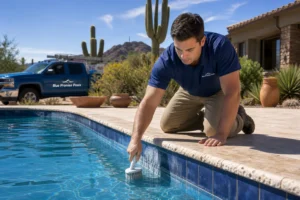
Achieving Crystal Clear Water: Scottsdale Pool Balance Tips from Blue Promise Pools
Keeping your Scottsdale pool water perfectly balanced is key to a clear, safe swimming experience and protecting your valuable equipment. This means expertly managing pH, sanitizer strength, alkalinity, calcium hardness, and stabilizer levels. This guide will walk you through what truly balanced pool water means, how Scottsdale’s unique desert conditions impact your pool’s chemistry, common signs of imbalance, and practical steps you can take before calling in the pros. You’ll discover the ideal numeric ranges specifically tailored for Arizona’s high-UV and hard-water environment, learn seasonal testing rhythms for summer and monsoon challenges, and find a handy problem-solution checklist for cloudy water, algae, and scaling. We’ll map out ideal ranges, climate-driven issues, DIY first-aid actions, and when it’s time to schedule professional testing or repairs. Plus, you’ll find quick-reference tables, actionable lists for fast answers, and clear guidance on how our professional weekly testing and emergency services can safeguard your pool’s health. By the end, you’ll know exactly what immediate adjustments to try and when to reach out for a free consultation or service estimate from your trusted local Scottsdale specialist.
Unlocking Perfect Pool Chemistry: Ideal Levels for Your Scottsdale Oasis

Balanced pool water ensures swimmer comfort, protects your pool’s surfaces and equipment, and keeps your sanitizer working effectively, especially under Scottsdale’s intense sun and with our hard water. Since evaporation concentrates dissolved solids and UV rapidly breaks down free chlorine, our target ranges are slightly conservative to maintain consistent safety and clarity. The table below outlines the core parameters, our recommended ranges, and why each is so crucial in our desert environment. Following the table, you’ll find quick corrective steps and a brief note on professional testing to help you bridge DIY action with reliable, expert adjustments.
| Key Parameter | Our Recommended Range | Why It’s Crucial for Your Pool |
|---|---|---|
| pH | 7.4 – 7.6 | Ensures chlorine works best, preventing irritation and scale in our intense sun. |
| Free chlorine (FC) | 1.0 – 3.0 ppm | Your pool’s primary defense against bacteria and algae, crucial with rapid UV breakdown. |
| Total alkalinity (TA) | 80 – 120 ppm | Stabilizes pH, preventing wild swings caused by evaporation and chemical treatments. |
| Calcium hardness | 200 – 400 ppm | Essential for preventing scale in Scottsdale’s hard water, protecting your plaster and equipment. |
| Cyanuric acid (CYA) | 30 – 50 ppm | Shields your chlorine from the harsh desert sun, keeping it effective without over-stabilizing. |
This quick-reference table is your go-to for prioritizing tests and making immediate corrections. If your levels are repeatedly off despite consistent dosing, professional testing can diagnose hidden causes and help us calibrate a lasting treatment plan for your pool.
What's the Perfect pH for Your Scottsdale Pool?
pH measures hydrogen activity, directly impacting how effectively your chlorine sanitizes and how comfortable your pool water feels to swimmers. In Scottsdale, we recommend aiming for a pH of 7.4–7.6. This range perfectly balances chlorine effectiveness with reduced corrosion of metal components and less scale formation from our naturally hard water. A low pH can speed up corrosion and sting skin, while a high pH drastically reduces chlorine potency and encourages cloudy water and scaling. Test your pH at least twice weekly in summer and make small, measured adjustments with acid or alkali. If you notice persistent drift after corrections, it’s a clear signal for professional analysis to check your total alkalinity and calcium hardness.
Balancing Chlorine & CYA: The Arizona Pool Secret
Free chlorine is your pool’s active sanitizer, while cyanuric acid (CYA) acts as its sunscreen, protecting chlorine from the intense UV breakdown. Both must be perfectly balanced for reliable disinfection in high-UV Scottsdale. Aim to maintain free chlorine around 1–3 ppm and CYA near 30–50 ppm. This ensures sunlight stabilization doesn’t overly bind your chlorine, keeping plenty of sanitizer available. If swimmers complain of chloramine odors or eye irritation, check your combined chlorine and consider a shock treatment to restore free chlorine levels. Regular monitoring during summer, after heavy use, or following storms is crucial to prevent sanitizer gaps. If you find you can’t restore free chlorine with standard dosing, our professional shock and testing services are here to safely reset your levels.
Scottsdale's Desert Climate: Your Pool's Biggest Challenge?
Scottsdale’s desert climate presents three unique challenges that constantly shift your pool’s chemistry: rapid evaporation concentrates dissolved minerals, intense UV quickly degrades free chlorine, and monsoon storms or dust entry introduce organics that fuel algae or cloudiness. These forces accelerate scale formation, raise pH and total dissolved solids, and significantly increase sanitizer demand compared to milder climates. Effectively managing these factors requires adjusted testing frequency, proper stabilizer presence, and smart preventative filtration routines. The short lists below summarize these climate effects and immediate actions you can take to minimize imbalance during seasonal shifts.
- Rapid evaporation concentrates minerals, boosting TDS and pH. Always top off with fresh water and retest.
- Intense UV quickly breaks down chlorine. Keep CYA in range and check FC daily during summer.
- Monsoon storms bring debris and organics. Boost filtration, skim often, and increase run-time to fight cloudiness.
These climate-focused steps are essential for reducing drift in key parameters and lead us right into our next topic: how Scottsdale’s hard water specifically drives calcium-related problems and scaling in your pool.
Hard Water & Your Pool: Understanding Calcium Hardness and Scaling
Calcium hardness refers to the dissolved calcium in your water and directly impacts the risk of scaling on your plaster, tile, and equipment when concentrations exceed saturation limits. Scottsdale’s source water often has a naturally high mineral content, so maintaining hardness at 200–400 ppm is a delicate balance between preventing scale and avoiding corrosion. Signs of scaling include a white crust at the waterline, a cloudy film on surfaces, and reduced heater efficiency. Prevention involves using sequestrants, careful pH and alkalinity control, and periodic professional descaling if deposits do form. If you notice visible scale or a drop in equipment performance, a Blue Promise Pools pro can evaluate your hardness, recommend precise sequestrant dosing, or perform targeted descaling to restore efficient operation.
Seasonal Shifts: Keeping Your Scottsdale Pool Balanced Year-Round
Seasonal changes in Scottsdale demand different testing cadences and chemical strategies for your pool. Summer calls for higher-frequency checks and shocking after heavy swim use, monsoon season requires rapid debris removal and proactive organic load management, and cooler months allow for longer test intervals but still need occasional balancing. Our recommended actions: test twice weekly in summer, increase filtration run-time during dust or storm events, and schedule a seasonal service visit to fine-tune your stabilizer and hardness plans. These seasonal routines are designed to minimize emergency treatments and directly highlight why many homeowners rely on our professional weekly service for consistent reporting and expert adjustments.
Common Pool Problems in Scottsdale? Blue Promise Pools Has Your Solution!
Common pool symptoms like cloudy water, algae blooms, staining or scaling, and persistent chloramine odors each stem from predictable Scottsdale-specific causes such as dust storms, high UV, and our hard source water. While immediate DIY steps often clear mild cases—like skimming, backwashing, small chemical corrections, and extended filtration—persistent or recurrent issues usually require professional diagnostics and tailored treatments. The table below maps these problems to their local causes, offers DIY triage steps, and tells you when it’s time to call a professional. Blue Promise Pools’ weekly pool service and pool repair options provide practical, lasting solutions for recurring imbalance and complex corrections.
| The Problem | Why It Happens Here | Your First Steps | Time to Call Blue Promise |
|---|---|---|---|
| Cloudy Water | Dust, high minerals, filter trouble | Skim, backwash, run filter longer, add clarifier | Still cloudy after 48 hours, or filter can’t keep up |
| Algae Bloom | Warmth + low chlorine after storms | Brush, shock, run filter, add algaecide | Algae keeps spreading or comes right back |
| Scaling/Staining | Hard water + high pH levels | Adjust pH/TA, use a sequestrant | You see scale, rough plaster, or clogged equipment |
| Chloramine Odor | Low free chlorine + lots of swimmers | Shock to breakpoint chlorination | Odor won’t go away or causes irritation after you shock |
Blue Promise Pools can step in with our weekly pool service to stabilize recurring chemistry issues and provide expert pool repair for equipment or surface problems. We provide measured reports after each visit, documenting all corrections and outcomes for your peace of mind.
Got Cloudy Pool Water? Here's How to Clear It Up!
Cloudy water can result from particulates, biological growth, or a chemical imbalance. Identifying the cause starts with checking your filter performance, free chlorine, pH, and any recent weather or usage events. First, skim and vacuum any visible debris, then backwash or clean your filter and run extended filtration while retesting your chemistry every 12–24 hours. If cloudiness follows storms or heavy use, add a clarifying agent and ensure proper sanitizer levels. Persistent cloudiness after these steps often suggests a need for professional testing for high TDS, filter media service, or specialized filtration—situations where our weekly service or repair work efficiently restores crystal clarity.
Say Goodbye to Algae: Prevention & Treatment for Scottsdale Pools
Algae prevention in Arizona is all about consistent sanitizer levels, routine brushing and filtration, and a rapid response after storms that introduce organics. Always maintain free chlorine within target, shock periodically after heavy use, and keep your CYA balanced to protect sanitizer from UV loss. If algae does appear, intensify filtration, brush all surfaces thoroughly, perform a shock treatment, and use algaecide as directed while diligently monitoring for re-growth. Professional remediation often includes concentrated shock, targeted algaecide, and a follow-up filtration protocol. If algae repeatedly returns, a Blue Promise Pools service plan with documented visits is your best defense against recurrence.
Why Trust Blue Promise Pools for Your Scottsdale Water Balancing?
Choosing professional testing means you get calibrated instruments, a consistent service cadence, and objective reporting that together prevent costly repairs and maintain swimmer safety, especially under our desert stressors. Our accurate, lab-grade instruments detect subtle patterns—like rising hardness, CYA drift, or persistent TDS increases—that DIY kits can easily miss. This enables targeted interventions that truly extend your equipment’s life. Below is a table mapping our key service features to the direct benefits you’ll enjoy, plus a brief list of recommended testing frequencies to help you decide when to rely on the pros versus DIY.
| Our Service Feature | What You Get | Your Key Benefit |
|---|---|---|
| Weekly Pool Service | Routine testing, precise dosing, equipment checks | Always-perfect water, fewer surprises |
| Detailed Service Reports | Clear notes and exact measurements | Full transparency to track your pool’s health |
| Emergency Response | 24/7 on-call repair and troubleshooting | Quick solutions for urgent pool issues |
Our Recommended Testing Schedule:
- Summer: Test your pool twice weekly, and always after a storm.
- Monsoon Season: Boost filtration run-time and test after any significant debris.
- Off-Season: Test weekly to keep that baseline chemistry just right.
Blue Promise Pools is a family-owned and operated business with deep desert expertise. We offer detailed service reports after each visit and provide 24/7 emergency service when urgent repair or balancing is required. For Scottsdale homeowners who prefer professional support and true peace of mind, request a free consultation or service estimate by calling (480) 710-0172 to discuss our weekly service, pool repair, or even new construction options.