Deciding between weekly pool service vs. diy pool care is one of the first questions Scottsdale homeowners face once a pool is up and running. Professional pool service delivers consistency, trained eyes on your pool equipment, and precise pool chemicals dosing every visit, while a diy pool approach works for hands-on owners willing to commit real time to the job every single week.
The Scottsdale Pool Reality: Why Consistency Is Non-Negotiable
A swimming pool in Scottsdale does not give you much margin for error. Intense desert sun, triple-digit summer temperatures, and monsoon storms shift pool water chemistry rapidly. UV radiation burns off free chlorine faster than in cooler climates, monsoon rain dilutes and contaminates the water overnight, and heavy bather loads during summer drive up sanitizer demand significantly.
The result is that pool maintenance in Scottsdale has to happen on a strict weekly schedule, not a "when I get to it" basis. A week of neglect in July can mean a green pool by the weekend. That is not just a cosmetic problem: a pool contaminated with algae or imbalanced pool chemicals puts swimmers at real health risk and typically requires an expensive shock treatment plus a multi-day recovery process.
Both weekly pool service and diy pool care can meet that consistency standard. The question is which approach actually fits your life.
What a Professional Pool Service Visit Covers
A professional pool service visit goes well beyond skimming leaves. A thorough weekly visit from a trained technician includes all of the following:
Water Testing and Chemical Dosing
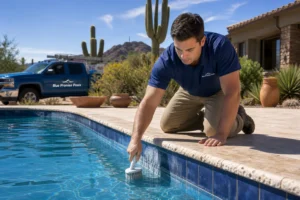
Pool water is tested on every visit for free chlorine, combined chlorine, pH, total alkalinity, calcium hardness, and cyanuric acid. Each pool chemicals dose is calculated precisely against current readings. Small errors compound quickly: low pH accelerates pool surface erosion and corrodes metal fittings, while high pH makes chlorine far less effective as a sanitizer.
Pool Cleaning and Brushing
The technician brushes walls, steps, and waterline tile to prevent algae from establishing a foothold. Pool cleaning also includes skimming the surface, emptying pump and skimmer baskets, and vacuuming the pool floor. Consistent pool cleaning reduces total organic load in the water, lowering the amount of sanitizer needed to keep the pool safe.
Equipment Inspection
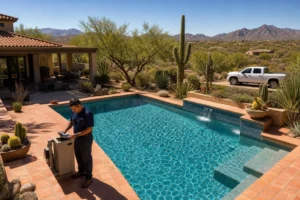
Professional pool service technicians inspect pool equipment on every visit. A pump running hot, a rising filter pressure gauge, or a leaking valve each signal a developing problem. Catching these issues early saves real money. Blue Promise Pools also handles pool repair directly, so one company covers both your ongoing maintenance and any repairs that come up along the way.
What DIY Pool Care Actually Requires
A diy pool owner needs to be honest about three things: chemistry knowledge, pool equipment familiarity, and time.
Chemistry Fundamentals
Pool chemicals interact in ways that are not always obvious. In Scottsdale's sun-heavy climate, cyanuric acid management is especially critical. Without enough stabilizer, UV radiation destroys your chlorine within hours of dosing. A study published by the Water Quality and Health Council (2020) found that improperly maintained residential pool water was a significant contributor to recreational water illness outbreaks across the country, underscoring why chemistry accuracy is not optional.
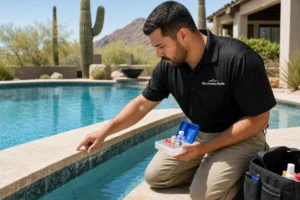
A liquid reagent test kit is the minimum tool for reliable pool maintenance. Strip tests are convenient but not accurate enough for consistent results in desert conditions. You need to understand the relationship between pH and chlorine effectiveness, how alkalinity buffers pH swings, and when to reach for a clarifier versus a flocculant for persistent pool water cloudiness.
Pool Equipment Knowledge
DIY pool maintenance means getting comfortable with your specific filter system, whether sand, cartridge, or diatomaceous earth. You need to know when to backwash, how to clean cartridge elements, what a healthy pump prime looks and sounds like, and how to spot a failing seal before it becomes a flooded equipment pad. Pool equipment problems diagnosed late almost always require full replacement instead of a straightforward repair.
Weekly Time Investment
Consistent diy pool care takes one to two hours per week during peak season, plus additional time for monthly tasks like heater checks, automation system testing, and post-monsoon debris clearance. Over a full year that adds up to 60 to 100 hours of active work, not counting trips to the pool supply store for pool chemicals and replacement parts.

When DIY Pool Maintenance Makes Sense
A diy pool approach is a reasonable choice when you genuinely enjoy hands-on work, have a background in chemistry or mechanical systems, and have consistent time in your schedule to check the pool after every weather event. Newer swimming pools with equipment still under warranty are also well-suited to diy care, since problems are less frequent and easier to spot early.
Some homeowners find real satisfaction in managing their own swimming pool, and when done with discipline, a diy routine keeps pool water clean and pool equipment running just as well as professional service.
When Professional Pool Service Is the Smarter Choice
For most Scottsdale homeowners, professional pool service is the practical call. It makes the most sense when:
- Your schedule is unpredictable or you travel frequently.
- Your swimming pool sees heavy use from children, renters, or frequent guests.
- You have dealt with recurring algae blooms or persistent chemistry imbalances under a diy routine.
- Your pool equipment is aging and benefits from a trained eye watching it each week.
- You would rather spend your weekends in the pool than working on it.
A care pool strategy that combines professional weekly visits with light spot-checks in between gives you consistent water quality without carrying the full technical load yourself.
Blue Promise Pools offers weekly pool service designed for Scottsdale's climate, covering water chemistry, pool cleaning, and equipment checks on every single visit.
Frequently Asked Questions
How often should a swimming pool in Scottsdale be serviced?
Weekly service is the standard recommendation for Phoenix-area pools. The combination of intense UV, heat, and monsoon season means pool water chemistry shifts faster than in most other climates. A weekly visit keeps chlorine levels stable, prevents algae growth, and gives a trained technician regular opportunities to catch pool equipment issues before they become expensive repairs.
What pool chemicals do I need for diy pool maintenance?
At minimum you need chlorine (tablets, granular, or liquid), muriatic acid to lower pH, sodium carbonate to raise pH, cyanuric acid stabilizer, alkalinity increaser, and calcium hardness increaser. Most Scottsdale diy pool owners also keep algaecide and a phosphate remover on hand, especially during monsoon season when organic load spikes after overnight storms.
Is professional pool service worth the monthly cost?
For most homeowners, yes. When you account for the value of your time, the difference between retail and bulk pool chemicals pricing, and the early detection of pool equipment problems, professional service typically pays for itself by preventing one or two repair calls per year. Equipment failures caught late are almost always more expensive than the weekly service visits that would have spotted them early.
Can I combine diy pool care with occasional professional visits?
Absolutely. Some homeowners handle day-to-day skimming and chemical top-offs themselves and schedule a professional pool service visit monthly for a comprehensive check. This hybrid approach works well for detail-oriented owners who want professional verification of their chemistry and pool equipment condition without committing to a full weekly service plan.
What is the most common diy pool care mistake in Scottsdale?
Neglecting cyanuric acid management. Without enough stabilizer, desert sun destroys your chlorine before it can sanitize the pool water. Too much, and chlorine effectiveness drops regardless of dose. Most professionals recommend maintaining CYA between 30 and 50 ppm for traditionally chlorinated pools in the Phoenix area.
Whether you are ready to hand off your weekly pool service or just want a professional assessment of your current pool water and pool equipment condition, the Blue Promise Pools team is here to help. Contact us today and we will build a pool maintenance plan tailored to your Scottsdale backyard and schedule.