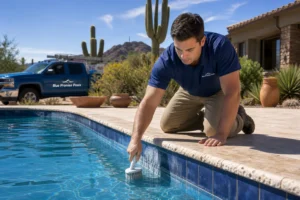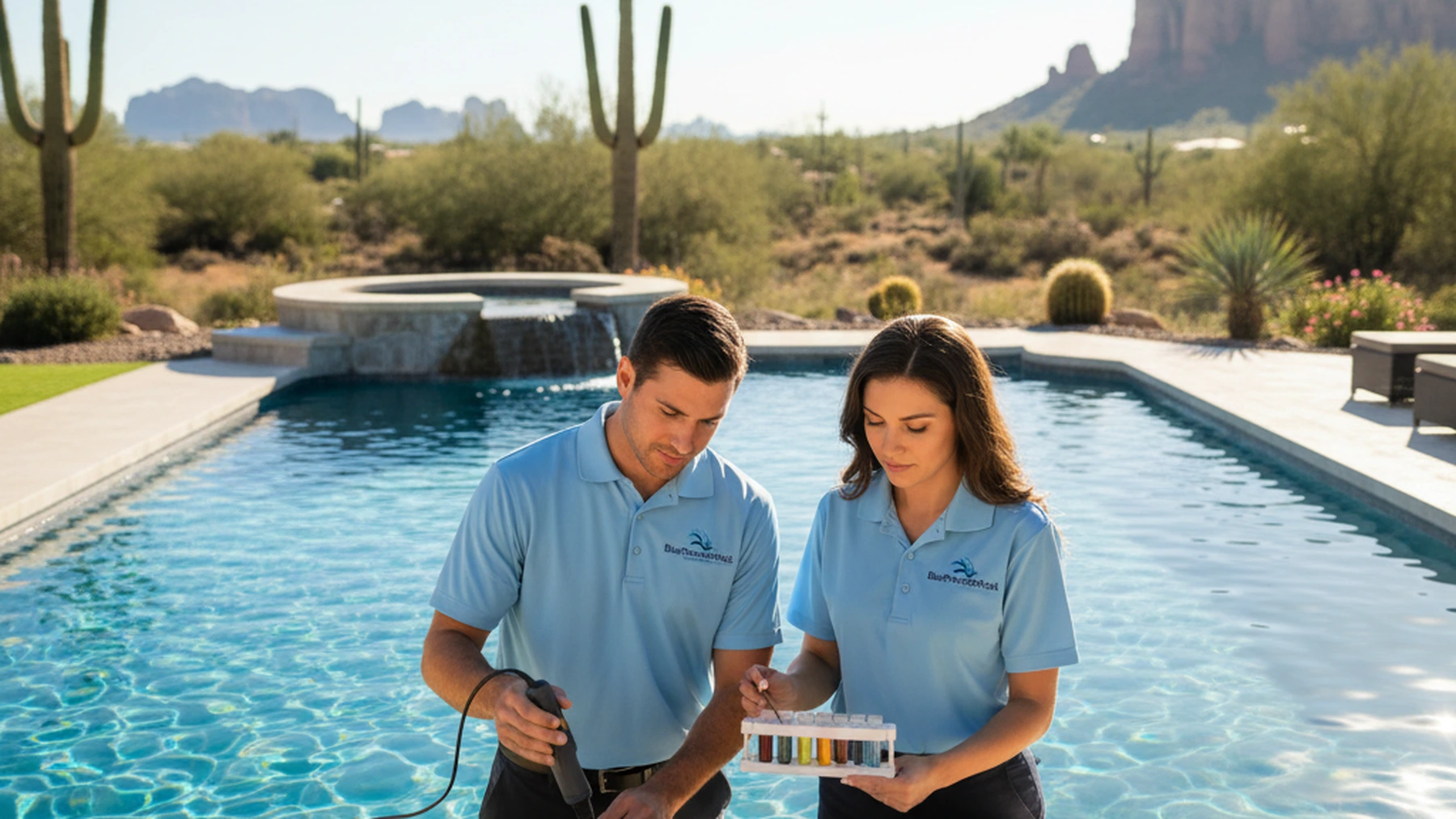
Pool chemistry basics in Arizona come down to maintaining the right balance of pH, alkalinity, chlorine, and salt levels in your pool water. In Scottsdale's intense desert climate, heat and sun create chemistry challenges that differ from pools in cooler regions, requiring more frequent testing and targeted adjustments to keep your water safe and clear.
Why Arizona Pool Chemistry Is Different
Scottsdale summers are not gentle to pool water. Intense UV radiation burns through chlorine faster than in most parts of the country. Evaporation rates are high, concentrating minerals and throwing off your chemical balance. And the desert air means homeowners are often swimming more months of the year, adding bather load that affects pool chemistry constantly.
Understanding these local conditions is the foundation of smart pool care. What works in a mild coastal climate may leave your Scottsdale pool green by July if you apply the same approach here.
Pool water chemistry is also affected by your water source. The City of Scottsdale pulls from Salt River Project surface water and groundwater, both of which carry varying mineral content depending on the season. That means your starting water chemistry can shift, and your chemical adjustments need to account for it.
Core Chemical Levels Every Arizona Homeowner Should Know
Getting your pool chemical levels right starts with knowing what to measure. Here are the key ranges recommended for Arizona pools:
pH (Power of Hydrogen)
- Ideal range: 7.4 to 7.6
- pH below 7.2 means your water is acidic. It irritates eyes and skin and corrodes pool equipment over time.
- pH above 7.8 means your water is basic. Chlorine becomes less effective, and calcium scaling becomes more likely, which is already a concern in Arizona's hard water.
Total Alkalinity
- Ideal range: 80 to 120 parts per million (ppm)
- Alkalinity acts as a buffer for pH. When alkalinity is properly balanced, your pH stays more stable between tests.
- Low alkalinity causes pH to swing unpredictably. High alkalinity makes it hard to correct pH at all.
Chlorine
- Free chlorine ideal range: 1.0 to 3.0 ppm
- In Arizona's summer heat, chlorine degrades rapidly. Many homeowners add chlorine and find their pool short on sanitizer within 24 to 48 hours.
- Stabilizer (cyanuric acid) helps protect chlorine from UV breakdown. Ideal stabilizer level is 30 to 50 ppm.
Calcium Hardness
- Ideal range: 200 to 400 ppm
- Arizona source water tends to run hard. Excess calcium leads to scaling on pool surfaces and inside your pump and equipment.
- Too little calcium causes water to pull minerals from the pool surface itself, which damages plaster and finishes over time.
Salt (for Salt Water Pools)
- Ideal range: 2,700 to 3,400 ppm
- Salt water pools use a salt chlorine generator to convert pool salt into chlorine. The pool still uses chlorine for sanitation. The difference is how it is produced and delivered.
- Pool salt levels that are too low prevent the generator from producing enough chlorine. Too high and you may notice a salty taste or corrosion on metal fixtures.
How to Test Your Pool Water

Testing is non-negotiable. You cannot manage pool water chemistry you are not measuring.
Testing methods:
- Test strips are the fastest option. Dip, wait a few seconds, compare colors to the chart. They are good for quick weekly checks.
- Liquid drop kits are more accurate for pH and chlorine. They take a few extra minutes but give you a clearer reading.
- Digital testers offer precision and remove the guesswork of color matching. A good digital tester covers pH and free chlorine at minimum.
- Professional lab testing is the most complete option. Drop a water sample at your local pool supply store and they will run a full panel. This is worth doing at least once at the start of the season.
How often should you test? At minimum, test twice a week during summer months. In Scottsdale's peak heat, weekly testing is not enough. Daily testing is not overkill if your pool gets heavy use.
Every test session should cover: pH, free chlorine, total alkalinity, and stabilizer. Add calcium hardness to your monthly checks.
Balancing Pool Water in Scottsdale: Step-by-Step
When your test results come back out of range, you need a clear order of operations. Here is the sequence that works:
- Adjust total alkalinity first. Add sodium bicarbonate to raise it. Use muriatic acid to lower it. Wait 4 to 6 hours and retest before moving on.
- Adjust pH second. Once alkalinity is stable, pH becomes much easier to dial in. Use sodium carbonate (soda ash) to raise pH. Use muriatic acid or dry acid to lower it.
- Shock the pool if chlorine is low. Shocking means adding a large dose of chlorine at once to kill bacteria, algae, and organic waste that has built up. Run your pump for the full shock cycle.
- Check stabilizer. Add cyanuric acid if it is below 30 ppm. If it is above 80 ppm, the only fix is a partial drain and refill.
- Balance calcium hardness. Add calcium chloride to raise it. Lower it by diluting with fresh water.
Do not try to fix everything at once. Chemical adjustments interact with each other, and stacking multiple chemicals in the same hour creates unpredictable results.
Salt Water Pool Chemistry: What Scottsdale Homeowners Need to Know
Salt water pools are popular in Scottsdale, and for good reason. They tend to feel softer on skin, require less frequent manual chlorine addition, and the steady output of a salt chlorine generator is well-suited to Arizona's demand for consistent sanitation.
But salt water pool chemistry still requires attention. Here are the specifics:
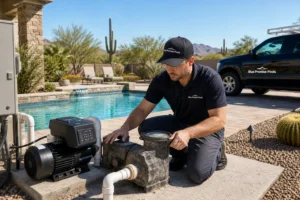
Your pump matters. The salt chlorine generator depends on your pump running enough hours per day to produce adequate chlorine. In summer, your pump may need to run 10 to 12 hours per day. An undersized or failing pump means your generator cannot do its job.
Salt levels need regular testing. Pool salt dissolves in water and does not evaporate, but when you drain water to lower other chemicals, you also lose salt. After rain or heavy splashing, test your pool salt level and adjust.
Salt water pools still need pH management. Chlorine generators produce a slightly alkaline byproduct. Over time, this tends to push pH up. You will likely add acid more often with a salt water pool than a traditional one.
Scale is a real concern. Arizona hard water plus the elevated pH common in salt water pools creates conditions where calcium scaling builds up on the generator cell. Inspect your cell every three months and clean it with a diluted acid solution if scale is present.
If you are considering converting your pool to salt water, or if your existing system needs service, our Pool Repair team can assess your setup and handle the work.
Seasonal Adjustments for Arizona Pools
Pool chemistry in Scottsdale is not static. It shifts with the seasons, and your maintenance routine should too.
Spring (March to May)
Open the season with a full professional water test. Shock the pool, check all chemical levels, inspect your pumps and equipment, and set your stabilizer before UV exposure climbs. This is your reset point.
Summer (June to September)
Peak demand. Chlorine consumption is highest. Test every two to three days. Run your pump on extended cycles. Watch for algae after monsoon rains, which introduce organic material and nitrogen into the pool water that feeds algae growth quickly.
Fall (October to November)
Ease back on chemical inputs as temperatures drop and bather load decreases. Continue weekly testing. Watch for calcium scaling as temperatures cool and evaporation slows.
Winter (December to February)
Scottsdale homeowners often continue using their pools year-round, which means chemistry maintenance continues. Chlorine demand drops in cooler months, but that does not mean you skip testing. Algae can still establish in mild Arizona winters.
When to Call a Professional
Some chemistry problems are best handled by a professional. Call us if you are dealing with:
- Persistent algae that returns after shocking
- Cloudy or foamy water that does not clear after chemical adjustment
- Scaling on your pool surface or equipment
- A salt chlorine generator that is not producing adequate chlorine
- A pump that is running but not circulating water effectively
Our Weekly Pool Service team handles the full chemistry routine for Scottsdale homeowners who want reliable, expert maintenance without the guesswork. We test, balance, and document every visit.
If your pool surface has calcium scaling that has built up over time, that may be a sign that Pool Resurfacing is worth exploring to restore the finish and protect the structure.
Take the Guesswork Out of Pool Chemistry
Balancing pool water in Scottsdale takes consistency, the right test schedule, and an understanding of how Arizona's climate affects chemistry differently than other parts of the country. The fundamentals are manageable once you know the right sequence and the numbers to aim for.
If you would rather leave it to a team that handles Scottsdale pool chemistry every day, we are here. Contact us to learn about our maintenance plans or to schedule a water test and consultation.
FAQ: Pool Chemistry Basics in Arizona
What are the ideal pool chemical levels for Arizona pools?
For Scottsdale pools, target pH between 7.4 and 7.6, total alkalinity between 80 and 120 ppm, free chlorine between 1.0 and 3.0 ppm, stabilizer (cyanuric acid) between 30 and 50 ppm, and calcium hardness between 200 and 400 ppm. Salt water pools should maintain pool salt levels between 2,700 and 3,400 ppm for the generator to function properly.
How often should I test my pool water in Scottsdale?
During summer months, test your pool water at least two to three times per week. Arizona's intense UV exposure burns through chlorine faster than in cooler climates, and heat drives evaporation that concentrates minerals. Weekly testing is not frequent enough when temperatures are above 100 degrees. A full professional water test at the start of the season is also worth doing.
Why does my Arizona pool use more chlorine than pools in other states?
UV radiation in Arizona is significantly more intense than in most other states, and sunlight degrades free chlorine rapidly. Cyanuric acid (stabilizer) helps protect chlorine from UV breakdown. Without adequate stabilizer, your chlorine may dissipate within a day. If your stabilizer is in the correct range and chlorine still depletes fast, high bather load or organic contamination may be the cause.
What is the difference between a salt water pool and a regular chlorine pool?
A salt water pool uses a salt chlorine generator to convert pool salt dissolved in the water into chlorine. Both pool types use chlorine as the primary sanitizer. The difference is delivery: salt water pools produce chlorine continuously from the generator rather than requiring you to add it manually. Salt water pools still require pH, alkalinity, and calcium management, and the generator depends on proper pump operation to work correctly.
How do I fix cloudy pool water in Scottsdale?
Cloudy pool water is usually caused by pH imbalance, low chlorine, or elevated calcium hardness. Start by testing all chemical levels. If pH is high, bring it down with muriatic acid. If chlorine is low, shock the pool and run the pump continuously until the water clears. If calcium hardness is very high, a partial drain and refill may be necessary. Persistent cloudiness after chemical correction can signal a filtration issue.